Barbell Front Squat: How to Do It, Muscles Worked & Form
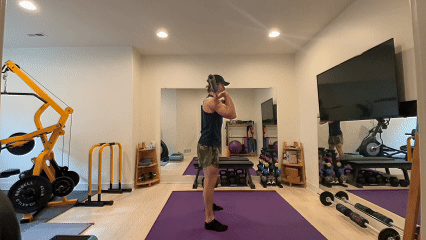
The barbell front squat is the most quad-dominant squat variation you can load heavily. The bar sits across your front deltoids instead of your upper traps, which forces a more upright torso and shifts the center of mass forward over your knees. That single mechanical difference means your quadriceps work harder than in any other barbell squat. The tradeoff is that the front-rack position demands real shoulder mobility and core strength, making it a hard exercise to get right but an outstanding one once you do.
Muscles Worked
- Quadriceps (primary): Rectus femoris, vastus lateralis, vastus medialis, and vastus intermedius drive the majority of the work. The upright torso and forward knee travel inherent to the front squat produce a deep knee bend that maximally loads all four quad heads.
- Glutes (secondary): Gluteus maximus contributes to hip extension as you drive out of the hole. The glutes do less absolute work than in a low-bar back squat but are still meaningfully loaded.
- Hamstrings (stabilizing): Biceps femoris, semitendinosus, and semimembranosus assist at the hip and help control depth, but their contribution is minor compared to the quads.
- Upper back and core (supporting): The front-rack position demands constant work from your thoracic extensors and upper traps to hold the bar in place, and your entire anterior core must stay braced to prevent forward collapse under load.
How to Do the Barbell Front Squat
- Set the barbell on a rack at shoulder height. Stand with your feet shoulder-width apart and grip the bar with an overhand grip slightly wider than shoulder-width. Step under the bar, positioning it across the front of your shoulders resting on the tops of your deltoids, with elbows lifted high and pointing forward. Cross your arms or use a clean grip to stabilize the bar, then step back from the rack.
- Brace your core firmly to maintain an upright torso and protect your spine. Activate your quadriceps, glutes, and hamstrings, and keep your chest lifted with your shoulders pulled back to support the bar.
- Inhale and brace, then lower your body by bending at the hips and knees simultaneously, keeping your torso upright and elbows high throughout the descent. Squat until your thighs are at least parallel to the floor, ensuring your knees track over your toes and your heels stay grounded.
- Exhale as you press through your heels and extend your knees and hips together to drive back to the starting position. Maintain a tight core and upright posture all the way to full lockout, then reset your breath before the next rep.
Coaching Cues
- Elbows up, always. The single most important cue for the front squat. If your elbows drop, the bar rolls off your shoulders. Think about pointing your elbows at the wall in front of you from start to finish.
- Chest tall, not forward. The front rack wants to pull you into a forward lean. Actively fight it by driving your sternum upward on every rep. A collapsed chest is the early warning sign that the weight is too heavy.
- Knees out over toes. Push your knees in the direction your toes point throughout the descent. This is both a technique cue and a safety cue: valgus knee collapse becomes a serious risk when the bar weight increases.
- Heel pressure throughout. Spread the floor with your feet and maintain even pressure from heel to midfoot. Rising onto your toes indicates tight ankles, which limit depth and put excessive stress on the knees.
- Brace hard, then descend. Take your air in before you start the descent. A half-brace at the top leads to a compromised position halfway down. Full intra-abdominal pressure, then go.
Common Mistakes
- Letting elbows fall: Elbows dropping forward is the most common cause of a failed front squat. The bar loses its shelf, slides down the arms, and either misses the lift or forces an emergency rack. Keep your upper arms parallel to the floor or higher.
- Forward torso lean: When your chest tips forward, the load transfers from your quads to your lower back and increases injury risk. If you cannot keep upright, the load is too heavy or your thoracic mobility needs work.
- Heels rising at depth: Heel rise almost always means tight ankle dorsiflexion. Temporarily elevate your heels on small plates to find your depth, and address ankle mobility in your warmup with calf stretches and ankle circles.
- Knees caving inward: Valgus collapse at the knee is a stability failure that compounds stress on the knee joint. Cue yourself to push the knees outward aggressively, and consider reducing load until glute and hip external rotator strength catches up.
- Cutting the squat short: Not reaching parallel depth turns the exercise into a partial rep that underloads the quads and overstresses the patella. If depth is the issue, work on hip and ankle mobility before adding load.
Sets, Reps & Programming
The barbell front squat suits both strength and hypertrophy goals, but its technical demands mean beginners should treat it as a skill exercise before chasing load. For strength, use 3 to 5 sets of 3 to 5 repetitions with 80 to 90 percent of your estimated one-rep max, resting 3 to 5 minutes between sets. For hypertrophy, 3 to 4 sets of 6 to 10 repetitions at 65 to 75 percent works well, with 2-minute rest periods. Many intermediate lifters run it as their primary squat variation on one lower-body day and pair it with hack squats or leg press for quad volume. Because the skill difficulty is rated hard, a new lifter should spend several weeks learning the front-rack position under light load before adding meaningful weight.
Safety
The front squat is demanding on wrist and shoulder flexibility, particularly in the clean-grip rack position. If your wrists ache with a full clean grip, the cross-arm grip is a reliable alternative that places less stress on the joints. Ensure you have working safeties set in the rack at approximately parallel depth so any miss can be dropped safely. Individuals with knee pain should focus on ankle mobility work before loading, since restricted dorsiflexion places excess compressive force on the knee joint. The exercise is generally lower spinal-load than the high-bar back squat due to lighter absolute weights, but axial spine loading still applies: maintain a neutral spine and brace fully on every single rep.
Track It in LiftLogic
The barbell front squat rewards patient, data-driven loading. Because the skill demands are high, progress can feel invisible without a clear record: your form is improving, your bar stays higher, your knees track better, but the numbers look flat. A training log shows you the actual progress across weeks. LiftLogic logs each set, weight, and rep, calculates your estimated one-rep max, and surfaces your personal records so you can see exactly when the front squat moved from a technique exercise to a strength exercise. Download LiftLogic free on the App Store.