Barbell Romanian Deadlift: How to Do It, Muscles Worked & Form
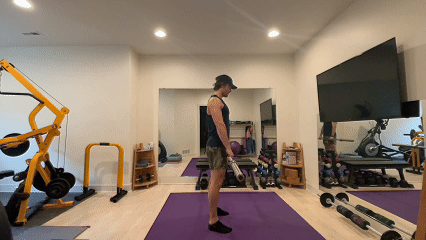
The barbell Romanian deadlift is the best barbell exercise for targeting the hamstrings under a long, high-tension stretch. Unlike the conventional deadlift, the bar never touches the floor: you control the descent against load the entire time, which is exactly why this lift builds so much posterior chain mass and hip hinge strength. If your hamstrings are the weak link in your squats, sprints, or conventional pulls, the Romanian deadlift belongs in your program and not just as an afterthought. Done correctly, it teaches the hip hinge pattern that transfers to almost every major compound movement you'll ever do.
Muscles Worked
- Hamstrings (primary): The biceps femoris long head, semitendinosus, and semimembranosus all drive the movement and experience a demanding stretch under load as the bar descends. The controlled eccentric is the reason this exercise builds hamstring mass so effectively.
- Glutes (primary): The gluteus maximus shows high activation at the top of each rep as you drive your hips forward into lockout. Hip extension is a glute-dominant action, and a full squeeze at the top completes each rep.
- Erector Spinae (stabilizer): The lower back muscles work isometrically throughout the movement to maintain a neutral spine against the forward pull of the load. They should never be the limiting factor: if your lower back fatigues first, your form has broken down.
- Lats and Upper Back (stabilizer): Pulling your shoulder blades down and back before and during the hinge keeps the bar close to your body and prevents your upper back from rounding under load. Think of your lats as the guardrails for the bar path.
- Grip and Forearms: Holding a loaded barbell through 8 to 12 reps with a stretched shoulder position means your grip is working throughout. This is a legitimate secondary benefit over time.
How to Do the Barbell Romanian Deadlift
- Stand with your feet hip-width apart, holding a barbell with an overhand grip just outside shoulder-width. Let the bar rest against the front of your thighs with arms straight, knees slightly bent, shoulders pulled back, chest lifted, and core engaged.
- Before hinging, actively squeeze your shoulder blades down and back to pre-activate your lats. Take a breath into your belly and brace your core firmly to protect your spine throughout the movement.
- Push your hips backward to initiate the hinge, keeping the bar dragging close along the front of your thighs and shins as you descend. Maintain a neutral spine and level hips. Lower until you feel a strong stretch in your hamstrings, typically when the bar passes your knees or reaches mid-shin.
- Drive your hips forward to reverse the movement, engaging your glutes and hamstrings as you return to standing. Lock out fully with hips extended and glutes squeezed at the top, then reset your brace before the next rep.
Coaching Cues
- "Hips back, not chest down." The movement is initiated by pushing your hips backward toward the wall behind you, not by leaning your torso forward. This distinction is what makes it a hip hinge and not a good morning gone wrong.
- "Drag the bar up your shins." The bar should almost scrape the front of your legs on both the descent and ascent. Any gap between bar and body means you are creating a longer moment arm, which transfers stress to your lower back instead of your hamstrings.
- "Soft knees only." Maintain a slight bend in the knees throughout the set. They do not straighten completely at any point, and they do not bend further as you descend. The angle stays roughly fixed so the hamstrings, not the quads, absorb the load.
- "Stop at the stretch, not the floor." Your range of motion ends where your hamstring flexibility ends, not where the plates would hit the ground. Forcing depth by rounding your lower back only shifts the load to your spine.
- "Slow the way down." A two-to-three second eccentric is where the hamstring stimulus lives. Dropping fast through the descent wastes the most important part of the rep.
Common Mistakes
- Rounding the lower back. The most common and most consequential error. Once your lumbar spine rounds under load, your erectors are absorbing force they were not designed to handle in that position. Keep your chest up and your natural lower back curve throughout every rep.
- Letting the bar drift away from the body. A bar that swings out in front creates a large moment arm and turns the lift into a recipe for lower back strain. Keep it close from start to finish.
- Bending the knees too much. Excessive knee bend shortens the hamstrings and reduces the stretch that makes this lift effective. Too much knee bend also turns it into a partial squat hybrid that splits the load in ways that serve neither movement.
- Not feeling it in the hamstrings. If you feel most of the work in your lower back, the hip hinge is not happening correctly. Try hinging with a lighter load or even a dowel rod to groove the movement pattern before adding weight.
- Hyperextending at lockout. Standing up past neutral and leaning backward at the top compresses the lumbar spine. A full lockout means hips extended, glutes squeezed, standing tall: not leaning back.
Sets, Reps and Programming
For hypertrophy, 3 to 4 sets of 8 to 12 reps works well. Use a controlled two-to-three second descent to maximize time under tension in the stretched position, which is where the hamstring growth signal is strongest. For strength-focused work, 4 to 5 sets of 5 to 8 reps at heavier loads are more appropriate. The Romanian deadlift is best placed as an accessory movement after your primary compound of the day: after conventional deadlifts on a pull day, or after squats on a leg day. It pairs well with leg curls or Nordic hamstring curls for complete posterior chain development. Most intermediate trainees do well running it once or twice per week, with at least 48 to 72 hours between sessions to allow full hamstring recovery. Because the hamstrings are loaded in a lengthened position, soreness after the first few sessions is significant: program lighter than you think necessary at first.
Safety
Start lighter than you think you need to. The hip hinge pattern is a skill, and the hamstrings are working in a stretched position under load, which is high-demand for muscles that are not used to it. If you feel sharp pain or discomfort in your lower back during or after the lift, treat that as a form signal: check your spine position, reduce the range of motion, and film yourself from the side to see what is actually happening. Warm up the hamstrings before loading with leg swings, bodyweight good mornings, or a light set of Romanian deadlifts with just the bar. Lifters with a history of hamstring strains should approach this movement conservatively: high eccentric load on an already-irritated hamstring can extend the injury. Mixed grip is not necessary for Romanian deadlifts; if grip is the limiter, use straps rather than altering your grip in a way that introduces asymmetry.
Track It in LiftLogic
The Romanian deadlift responds directly to consistent progressive overload: small weight increases over time add up to serious hamstring development, but only if you are actually tracking the numbers. LiftLogic logs every session, flags your personal records, and projects your next training max so you always know exactly when to add weight. If you are running a program where the RDL is an accessory lift, LiftLogic keeps your accessory work from becoming sloppy freeform sets with no progression logic. Download LiftLogic free on the App Store.