Overhead Barbell Press: How to Do It, Muscles Worked & Form
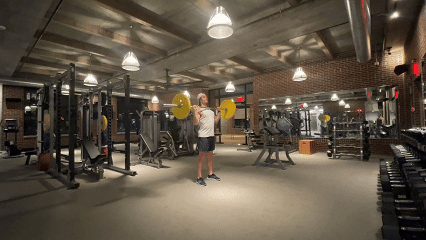
The overhead barbell press is the most direct test of upper-body pressing strength. It loads your entire shoulder complex, your triceps, and your upper traps in one coordinated movement, while demanding full-body tension to keep the bar on a clean vertical path. Unlike machine presses or dumbbell variations, the barbell ties both arms together into a single force vector, so there is nowhere to hide a weak side or a breakdown in core stability. Master the setup and the bracing, and the overhead press will add more shoulder strength and mass than any isolation exercise can match.
Muscles Worked
The overhead press is primarily a shoulder exercise, but it is truly a full-body effort. Here is how the load is distributed:
- Anterior Deltoid (Front Delt): The primary mover, contributing roughly 35% of the pressing force. It initiates the drive from the rack position and keeps the bar moving through the sticking point.
- Lateral Deltoid (Side Delt): Contributes approximately 25% of the lifting force. Training the lateral head in a pressing pattern, rather than only in raises, builds real shoulder width under load.
- Posterior Deltoid (Rear Delt): Stabilizes the humeral head in the socket throughout the movement, protecting the shoulder joint during heavy pressing.
- Triceps (Long, Lateral, and Medial Heads): Drive elbow extension through the middle and upper portion of the lift, accounting for roughly 25% of total force output. The long head is especially active because the arm is elevated above the shoulder.
- Upper Chest (Clavicular Pectoralis Major): Assists during the initial drive off the front-rack position, contributing a small but real portion of the pressing power.
- Upper Trapezius and Serratus Anterior: Upwardly rotate the scapula as the bar travels overhead. Full lockout is not possible without this rotation, and skipping it leaves you short of range and increases impingement risk.
How to Do the Overhead Barbell Press
- Set the barbell in a squat rack at upper-chest height. Stand facing the bar with your feet shoulder-width apart. Grip just outside shoulder-width, palms facing forward, and position your elbows directly under the bar so they point at the floor.
- Dip under the bar so it rests across the front of your shoulders just above your clavicles. This front-rack position means the bar contacts the deltoid shelf, not just your hands. Your wrists will be loaded, so your grip keeps the bar from rolling, not from falling.
- Brace your core: fill your belly with air, tighten your abs, squeeze your glutes, and press through the floor. Keep your chest up and your spine stacked vertically. Stand to unrack, step back with two short steps, and set your feet.
- Without leaning back or letting your lower back hyperextend, drive the barbell straight overhead. The bar should travel in a nearly vertical line. Tip your head back slightly to clear the bar past your face, then return your head to neutral as the bar passes overhead.
- Fully extend your arms at the top. Shrug your traps slightly to achieve complete scapular lockout, with the shoulder blades upwardly rotated and elevated. Your ears should be in line with your upper arms, not in front of them.
- Lower the bar under control along the same vertical path, keeping your elbows slightly in front of the bar as it descends. Return to the front-rack position with your core still braced, and repeat for reps.
Coaching Cues
- "Elbows under the bar." Before pressing, confirm your elbows are directly beneath the bar. Elbows drifting behind the bar shift your torso into a backward lean before the rep even starts.
- "Squeeze your glutes." Glute tension is the fastest correction for lower-back hyperextension at the top. If your ribs are flaring and your back is arching, tighten your glutes and the problem usually resolves immediately.
- "Bar traces the ears." As the bar moves overhead, it should pass close to your ears. If it is drifting forward of your ears, you are leaning backward too much rather than pressing straight up.
- "Proud chest." Keep your sternum lifted and your upper back tight throughout the rep. A collapsed thorax shortens range and invites shoulder impingement at lockout.
- "Full shrug at the top." Many lifters stop just before full lockout. Shrugging the traps at the top completes the scapular upward rotation and is where the upper trap and serratus get their full training stimulus.
Common Mistakes
- Excessive lower-back arch: The most common error. It usually means tight thoracic extensors or insufficient core bracing. Brace before the rep starts, squeeze your glutes, and if the arch persists, work on thoracic mobility before pressing sessions.
- Pressing forward instead of straight up: A forward bar path shortens the range of motion and places more load on the anterior capsule of the shoulder. Stay tall and drive the bar vertically.
- Elbows too wide at setup: Gripping very wide with elbows flared to the sides puts the shoulder in an internally rotated position, which is a setup for impingement. Elbows roughly 30 to 45 degrees from the torso works for most people.
- Cutting the range of motion short: Stopping a few inches above head height avoids the hardest portion of the lift and cheats the traps and serratus. Commit to full lockout every rep.
- Dropping the bar fast: An uncontrolled descent removes time under tension and forces the shoulder to absorb the load rather than the muscles decelerating it. Lower with as much intent as you press.
Sets, Reps & Programming
The overhead press responds well across rep ranges, but each target calls for a different approach. For maximal strength, run 4 to 6 sets of 1 to 5 reps with 3 to 5 minutes of rest, focusing on adding small amounts of load over weeks. For hypertrophy, 3 to 5 sets of 6 to 12 reps with 60 to 90 seconds of rest provides the time under tension the deltoids and triceps need to grow. For volume work or conditioning, 3 to 4 sets of 12 to 20 reps with lighter loads adds shoulder work without heavily taxing recovery. Program the overhead press as a primary lift on an upper or push day, and pair it with horizontal pulling movements (barbell rows, face pulls, cable rows) in roughly equal volume to keep the shoulder balanced and healthy over the long run.
Safety
Always use collars: an uneven bar is significantly more dangerous overhead than at the floor. Press in front of the neck, not behind it: behind-the-neck pressing puts the rotator cuff and cervical spine in a high-risk position without meaningfully increasing deltoid activation. If you experience shoulder pinching, check grip width (slightly narrower often helps), verify your elbows are under the bar before the rep starts, and make sure you are fully upwardly rotating the scapula at lockout rather than stopping short. For maximum-effort singles or near-max sets, use a spotter. The front-rack position allows you to absorb a failed rep on your shoulders in an emergency, but a trained spotter eliminates that risk entirely. Finally, if your thoracic spine is stiff and you compensate by hyperextending the lumbar, address that with mobility work before pressing heavy: a few minutes of foam rolling and thoracic extension before each session can make a real difference over time.
Track It in LiftLogic
The overhead press is a slow grind: progress comes in small increments over months, which makes accurate logging essential. Without a record of your last session, you are guessing at what to hit next. LiftLogic logs every set, weight, and rep automatically and shows your progression on each exercise so you always know exactly where you stand and what number to chase. Download LiftLogic free on the App Store.